

Industrial operators in France face rigorous logistics and environmental demands that compromise standard packaging integrity.
Standard bags often fail under UV exposure or humidity during long-distance transport across Europe, leading to product spoilage and waste.
Traditional stitching often ruptures under the weight of dense fertilizers or chemicals, causing hazardous spills and operational downtime.
Low-resolution printing on basic woven materials fails to convey the premium quality of French agricultural and chemical brands.
Incompatible bag structures lead to clogging in automated filling lines, reducing the throughput of large-scale production facilities.
Strict EU regulations regarding packaging durability and sustainability force companies to seek higher-grade polymers that reduce environmental leakage.
Frequent bag bursts during warehousing lead to expensive cleanup operations and the loss of high-value raw materials.
We integrate advanced materials and structural design to eliminate common failure points in industrial packaging.
Utilizing high-grade PP resins with UV inhibitors to prevent brittleness and material breakdown during outdoor storage and transit.
Implementation of pinch bottom bags to provide a leak-proof, high-strength closure that eliminates sewing gaps.
Applying a biaxially oriented polypropylene film to create bopp laminated bag options with photographic print quality and moisture barriers.
Precision-engineered valve bags that integrate seamlessly with automated filling equipment to ensure rapid, air-free filling cycles.
Customizing the mesh density of our pp woven bag structures to support high-density loads without stretching.
Adding specialized coatings to the inner layer of woven fabric to prevent fine powder leakage in fertilizer packaging bags.


Our operational strength is built on a foundation of specialized engineering and rigorous quality control.
France represents a sophisticated intersection of agricultural heritage and chemical innovation, requiring specialized containment solutions.
The French industrial sector, particularly in regions focused on agriculture and fine chemicals, relies heavily on high-durability polymers. The market environment is characterized by a shift toward specialized printed pp woven bags that serve both as protective shells and marketing tools. With a strong emphasis on logistics efficiency, French operators demand packaging that can withstand the rigors of automated palletizing and long-haul transport across the EU, where mechanical stress on bag seams is a primary concern.
Current trends indicate a significant transition toward high-barrier laminations. The adoption of BOPP films is increasing as brands seek to eliminate moisture ingress and enhance the aesthetic appeal of their products. Furthermore, there is a growing demand for "smart packaging" features, where structural integrity is coupled with clear, durable labeling to meet strict traceability requirements. The push for sustainability is also driving the industry toward higher-strength materials that allow for thinner walls without sacrificing load-bearing capacity.
The primary opportunity in the French market lies in the transition from traditional sewn bags to advanced closure systems like pinch bottom technology. As operational costs rise, the reduction of product loss due to bag rupture offers a direct ROI for manufacturers. However, the constraint remains strict adherence to European safety and environmental standards. Companies that can provide certified, high-precision packaging that reduces leakage and optimizes space will maintain a competitive edge in the evolving French industrial landscape.
From simple containment to strategic brand ambassadors, packaging technology has undergone a radical transformation.
Industry players are moving toward mono-material PP structures to simplify the recycling process within EU waste management frameworks, ensuring that high-strength packaging does not hinder circular economy goals.
The demand for bags specifically designed for high-speed robotic filling is growing, requiring tighter dimensional tolerances and optimized opening mechanisms to prevent line stoppages.
Specialized coatings are being integrated into woven fabrics to protect sensitive fine chemicals from oxidation and humidity, extending the viability of products in diverse climates.
The packaging industry is evolving to balance extreme durability with environmental responsibility and digital integration.
Integration of bio-based PP and recycled polymers to reduce the carbon footprint of industrial bags without compromising the tensile strength required for heavy loads.
Development of nano-composite additives that provide superior protection against solar degradation, essential for agricultural bags stored in open-air French fields.
Incorporating QR-coded lamination layers that allow logistics managers to track batch numbers and origin data instantly via mobile scanning.
Applying anti-static treatments to PP woven bags used for fine chemical powders to prevent hazardous dust explosions during high-speed filling.
The intersection of material science and digital logistics is redefining the role of the industrial bag. In France, where the agriculture sector is highly integrated with retail chains, the move toward a "smart, sustainable shell" is no longer optional. This involves optimizing the thickness-to-strength ratio to reduce plastic volume while maintaining the rigorous safety standards required for hazardous materials transport.
Furthermore, the shift toward customized, high-resolution printed bags is allowing manufacturers to communicate sustainability certifications directly on the packaging. This transparency is critical for maintaining trust with European end-users who prioritize ecological footprints alongside product performance, driving the demand for lamination techniques that are both aesthetically superior and recyclable.
Our packaging solutions are engineered for the specific operational demands of diverse industrial environments.
In the humid coastal climates of Normandy, fertilizer manufacturers require fertilizer packaging bags with high-barrier lamination. Our BOPP-coated PP woven bags prevent moisture absorption, ensuring the chemicals remain granulated and free-flowing, which prevents clogging in distribution machinery and protects the product's nutrient integrity during storage.
Companies in the Lyon chemical cluster often export high-purity powders that are sensitive to contamination. By implementing pinch bottom bags, these operators eliminate the risk of leakage through sewn seams. The airtight closure ensures that fine powders remain secure during vibration-heavy sea and rail transport to international markets.
Large-scale grain cooperatives in the Paris Basin utilize high-tensile pp woven bag solutions to handle heavy volumes of wheat and corn. The reinforced weave density prevents bursting during mechanical loading, while the breathable nature of the woven structure (when not laminated) prevents condensation and mold growth within the silos.
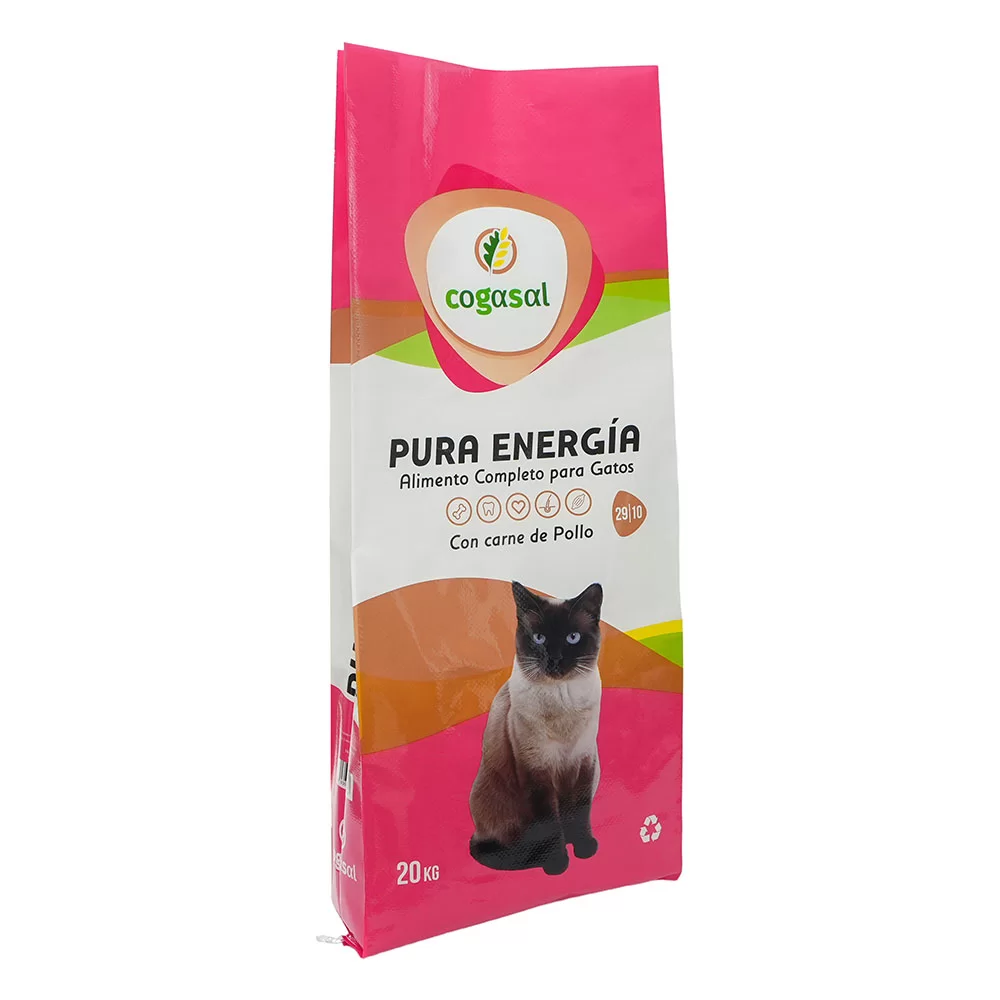
Feed producers in the south of France use printed pp woven bags to differentiate their premium organic feeds. The BOPP lamination allows for vibrant, high-resolution imagery that withstands abrasion during rough handling in farm environments, ensuring the brand identity remains intact from the factory to the trough.
Suppliers of building materials in Marseille require bulk bags (FIBCs) and heavy-duty woven sacks for cement and aggregates. Our reinforced polymer structures are designed to resist tearing against sharp aggregate edges, reducing material loss during the loading and unloading process at the port, thereby lowering operational waste.
How tailored packaging solves critical operational bottlenecks for industrial operators.
Typical agricultural operators find that switching to UV-stabilized laminated bags significantly reduces the rate of product degradation in outdoor storage. The transition from sewn seams to pinch-bottom closures eliminates the common problem of powder leakage during pallet movement, leading to cleaner warehouses and reduced material loss.
For chemical producers, the primary gain is the integration of BOPP lamination. This allows for a high-resolution brand presence that doesn't peel or fade under harsh conditions. Combined with reinforced PP weaves, the packaging survives the high mechanical stress of automated filling lines without rupturing, optimizing overall throughput.
Logistics managers often highlight the reduction in transit damage when moving to precision-engineered woven sacks. The consistent dimensional stability of these bags ensures that pallets are stacked perfectly, reducing the risk of tipping during transport across Europe and decreasing the number of rejected shipments due to packaging failure.
Combining innovative design with meticulous craftsmanship to wrap your excellence in strength.
Established in the heart of Hebei, China, focusing on the design and supply of high-quality, customized packaging solutions for critical industrial sectors including fine chemicals and agriculture.
Developed a robust technical core comprising 8 senior engineers, 28 engineers, and 51 skilled technicians, enabling the company to tackle complex structural challenges in polymer weaving.
Transformed into a strategic partner for international brands, leveraging advanced manufacturing technology to deliver precision-engineered woven bags, FIBCs, and BOPP laminated solutions worldwide.


Expert insights on selecting and implementing industrial polymer packaging.
The primary advantage is the creation of a superior moisture and oxygen barrier combined with photographic-quality printability. While standard woven bags are breathable and limited to basic printing, BOPP lamination seals the weave, preventing external contaminants from entering and internal powders from leaking. This is critical for products like fine chemicals or animal feeds in the French market that require extended shelf-life and high brand recognition.
Pinch bottom bags utilize a heat-sealed or specialized folded closure instead of traditional stitching. This removes the "needle holes" found in sewn bags, which are common failure points where fine powders can leak. In high-speed automated filling lines, this design ensures a more stable bag structure that doesn't distort during the fill cycle, significantly reducing the risk of bag bursts and ensuring a safer, cleaner operational environment.
Yes, we engineer our bags to meet the rigorous durability and safety standards required within the European Union. We focus on using high-grade, stable polymers that minimize microplastic shedding and maximize recyclability. By optimizing the material thickness-to-strength ratio, we help clients reduce the total volume of plastic used per unit while ensuring the packaging exceeds the mechanical requirements for industrial transit and storage.
For fertilizers, the key considerations are moisture resistance and tensile strength. Fertilizers are often hygroscopic, meaning they absorb moisture from the air, which can cause caking. A laminated PP structure is essential to keep the product dry. Additionally, because fertilizers are dense and abrasive, a reinforced weave density is required to prevent the bag from stretching or tearing under the weight of the product during vertical stacking in warehouses.
A valve bag features a specialized opening (the valve) that allows the bag to be filled from the top and then automatically closes under the pressure of the product, eliminating the need for manual sewing. Standard back-seam bags are typically open-top and require a separate closure process. Valve bags are far more efficient for high-volume, automated production lines, as they reduce labor costs and minimize the air trapped inside the bag, allowing for denser palletization.
The process begins with a detailed analysis of your product's physical properties (density, granularity, moisture sensitivity) and your filling equipment's specifications. Once these are established, our engineers recommend the optimal material, weave density, and closure system. We then provide structural prototypes for testing on your actual production line to ensure a perfect fit and maximum efficiency before moving to full-scale production.
Whether you are managing chemical exports in Lyon or agricultural distribution in Normandy, the right packaging prevents loss and enhances brand value. Contact our engineering team to discuss how our precision-woven solutions can reduce your operational waste and increase your distribution efficiency across France and Europe.
Request a Technical ConsultationHit enter to search or ESC to close


